 Michael Torres
Key Takeaways
- F10 is a communication failure between the main control board and a secondary board, and F5 is the board reporting its own internal failure.
- A loose ribbon cable between boards is the cheapest cause of F10, and reseating it costs nothing.
- F5 on every power-up, before any use, almost always means the board needs replacing.
- A power surge or brownout can corrupt or damage the board, so a surge suppressor belongs with the repair.
- Under about 12 years a board repair is generally worth it; at 15 years or more, get a full assessment first.
The Bottom Line
Reset, reseat the cable and note the pattern first. Repair the board on a range under about 12 years old and judge an older range as a whole.
On a DCS range the control board is the one part where a small fault can look like a total failure. A dark display, an oven that will not respond, burners that work while the oven does not: all of it can trace back to one board, or to a ribbon cable that has worked loose between two of them. Whether the board is worth replacing is a different question from whether the range is worth replacing, and mixing the two up is the commonest way to spend too much. This guide separates them. It sits under our DCS range repair or replace framework, which sets out the age and cost rules the table below applies to the board.
| Situation | Lean toward | Reason |
|---|---|---|
| F10 that clears after the ribbon cable is reseated | Repair, no part needed | A loose connector is the cheapest possible cause |
| F10 or F5 after an outage or surge, gone after a long reset | Keep the range, add surge protection | A transient glitch is not a failed board |
| F5 on every power-up, range under about 12 years | Repair with a new board | The range has plenty of life left |
| Board failure on a range 15 years or older | Full assessment first | Other aging parts are likely to follow |
| Board is the second major repair in a short time | Lean toward replacing | The pattern says the range is wearing out |
DCS Range Control Board Repair or Replace: When Each Is Right
Repair the board when the range is under about 12 years old and the board is the only real fault, and replace the range only when the board failure sits on top of age or other failing parts. In any DCS range control board repair or replace situation, three facts settle it: how old the range is, whether this is the first big repair, and what the written estimate is as a share of the range's replacement value.
The parent framework applies the fifty percent rule, which says replacement is usually the better investment when a repair exceeds half the current replacement value. Because new DCS ranges are priced at the top of the residential market, a board repair on a sound range almost never gets near that line. It gets near it when the range is old.
What Do F10 and F5 Mean for the Board?
Both point at the electronics, but they say different things. This site's code pages describe them separately.
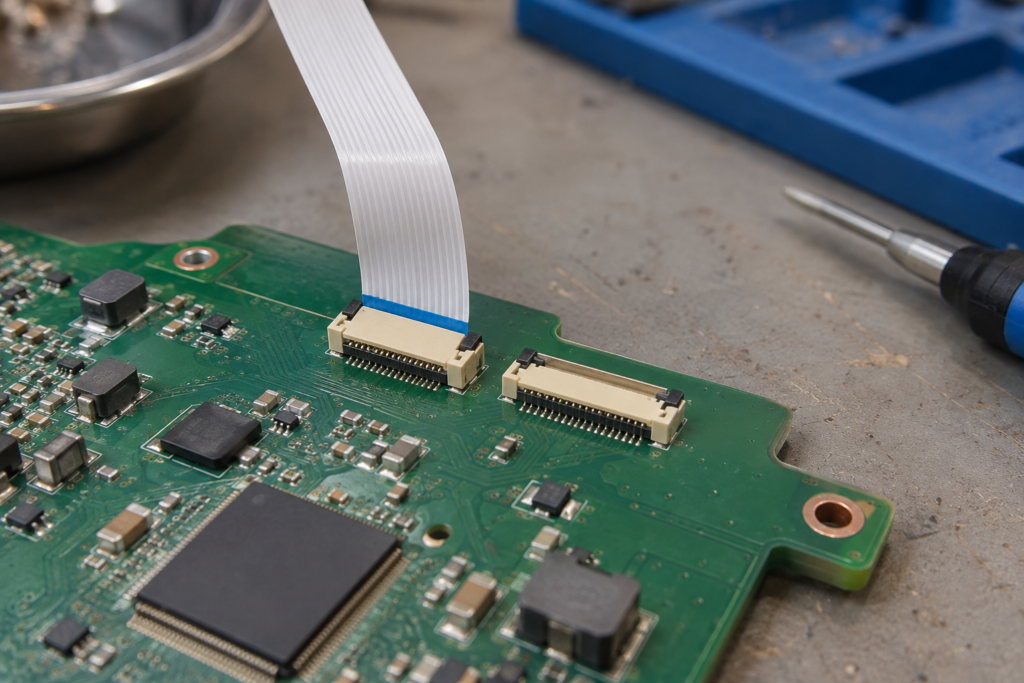
- F10 on the range — a communication failure between the main control board and a secondary board, usually the display. The causes are a failed main board, a failed or cracked secondary board, or a loose ribbon cable or connector between them. The last of these is the one a homeowner can sometimes fix.
- F5 on the wall oven — the control board's own report of an internal failure, unlike F1 to F4, which point at particular sensors or circuits. The causes are a failed main board, corrupted firmware or memory, or damage from a severe power event.
It is worth keeping the difference between the two in mind, because F10 is a conversation between boards and F5 is one board talking about itself. The first can be a cable, while the second almost never is.
The F5 page gives one rule of thumb worth knowing: if F5 appears on every power-up, before the oven has been used at all, board replacement is almost always needed. Intermittent F5 that follows a power event may settle after a long reset.
Can a Power Surge Kill a Range Board?
Yes. Both code pages list power disturbances among the causes, from a voltage spike or brownout that corrupts the board's memory to a major surge that physically damages components. They also name the protection: a whole-home surge suppressor, and for a wall oven a dedicated circuit.
That matters for the repair-or-replace decision in one specific way. If a surge caused the failure, a new board in an unprotected home is exposed to the same event, so the repair is only half the job. Add the suppressor, and the board repair is as good as new.
What Should You Try First?
Four steps cost nothing and settle the cheap causes before any decision is needed.
- Do a hard power reset. Switch the dedicated breaker off for five minutes for F10, or fifteen minutes for F5, so the board capacitors discharge fully, then restore power.
- Think back to the last power event. Did the fault appear after an outage, a storm or a brownout? Check the main panel for tripped breakers or a spent surge protector.
- With the power off at the breaker, look at the inter-board cable if the control panel can be reached, and gently reseat any connector that has play. Never crease a ribbon cable, because the fine traces inside break permanently.
- Note the pattern. Does the code appear on every power-up, or only after some use? A technician can tell a replacement from a reflash by that alone.
If the fault stays gone after a reset and a reseat, you have saved the whole repair. If it returns within days, treat the board as failing and get a diagnosis.
How Do Age and Repair History Decide It?
They decide it more than the code does, because the board is rarely the only part of an old range that is wearing out. Our parent framework gives clear lines.
- Under about 12 years: a control board repair is generally worth completing, because the range still has substantial life.
- 15 years or older: get a full assessment before authorizing anything, since a board failure at that age often comes with other electrical aging.
- A second big repair soon after the first: a sign the range is nearing the end of its useful life, whatever the second part is.
- A range in good cosmetic and structural condition: usually cheaper to repair than replace, which favors keeping it.
- A fault that followed a documented power event: more likely a one-off than a sign of wear, which also favors repair.
- A display that has already been replaced once: a hint that something upstream, such as the main board or the supply, is stressing the electronics.
The final repair price is confirmed after an on-site diagnosis, with a written estimate before work begins, and that estimate is the number the fifty percent rule needs. Our DCS range worth-repairing guide and the range repair costs guide help with the rest of that sum.
Getting the Board Looked At
Have the code, the model, the approximate age and the pattern ready. The F10 page and the F5 page list the safe checks in order, and our DCS range repair service diagnoses which board is the source before any part is ordered. Book a visit or send us the code and how the range behaves, and we will tell you which row of the table you are likely to be in.