 Michael Torres
Key Takeaways
- Two fans matter: the evaporator fan moves cold air inside and the condenser fan sheds heat from the coil.
- Check for ice or debris, then try the blade by hand with the unit unplugged.
- A blade that spins freely but a fan that does not run points to a failed motor.
- Fixing the fan usually beats replacing the unit, unless compressor, frost or board problems show up too.
The Bottom Line
Clear any ice or debris and test the blade by hand. If the motor or wiring has failed, repair it rather than replace the unit, unless the refrigerator shows other signs of wear.
An outdoor refrigerator that has stopped cooling well often turns out to have a fan problem rather than a compressor one, and that difference is the difference between a modest repair and a conversation about a new unit. The FAN-FAIL page on this site explains that the system relies on two fans, an evaporator fan that circulates cold air through the cabinet and a condenser fan that pulls air across the coil to shed heat. When either stops, cooling falls off quickly. This guide helps you decide whether to fix the fan or replace the unit. For the bigger question about the whole refrigerator, see the parent guide, DCS outdoor refrigerator repair or replace.
| Finding | Likely cause | Fix or replace? |
|---|---|---|
| Blade jammed by ice, a leaf or debris | Obstruction, sometimes with a stalled motor | Fix, clear it first |
| Blade spins freely by hand but fan will not run | Burned-out motor winding | Fix, replace the motor |
| Fan stops and starts, wiring looks corroded | Wiring harness failure | Fix, usually a small repair |
| Fan fine, no power reaching it | Control board relay or component | Weigh the board against the age of the unit |
How Do You Tell a Fan Failure From a Compressor Problem?
By listening and feeling for air. The compressor can run normally while a stopped fan leaves the cabinet warm, because without moving air the cold never reaches the shelves and the heat never leaves the coil. The page lists four signs of a fan failure, and they separate it from a compressor fault fairly well.
- No airflow inside the cabinet — a hand near the fan grille feels no moving air even though the compressor is running.
- Poor cooling with a running compressor — the unit runs but the interior stays warm.
- Unusual silence — the soft hum of the fans is missing, leaving only compressor noise or nothing at all.
- A very hot condenser area — the rear or bottom of the unit is abnormally hot because the condenser fan is not pulling air across the coil.
- Burning smell from the fan area — the page lists it as a stop-immediately sign, so unplug the unit and do not run it.
A compressor that clicks and will not start is a different fault, covered on the COMP-CLICK page.
What Can You Check Before Deciding?
Three checks, all described on the FAN-FAIL page, and all done with the unit unplugged where the blade is involved. The page says to remove perishables immediately, because the unit cannot hold safe temperatures without the fans.
- Listen and feel for each fan — with the door open, listen for the evaporator fan, then close it and listen at the rear or bottom for the condenser fan.
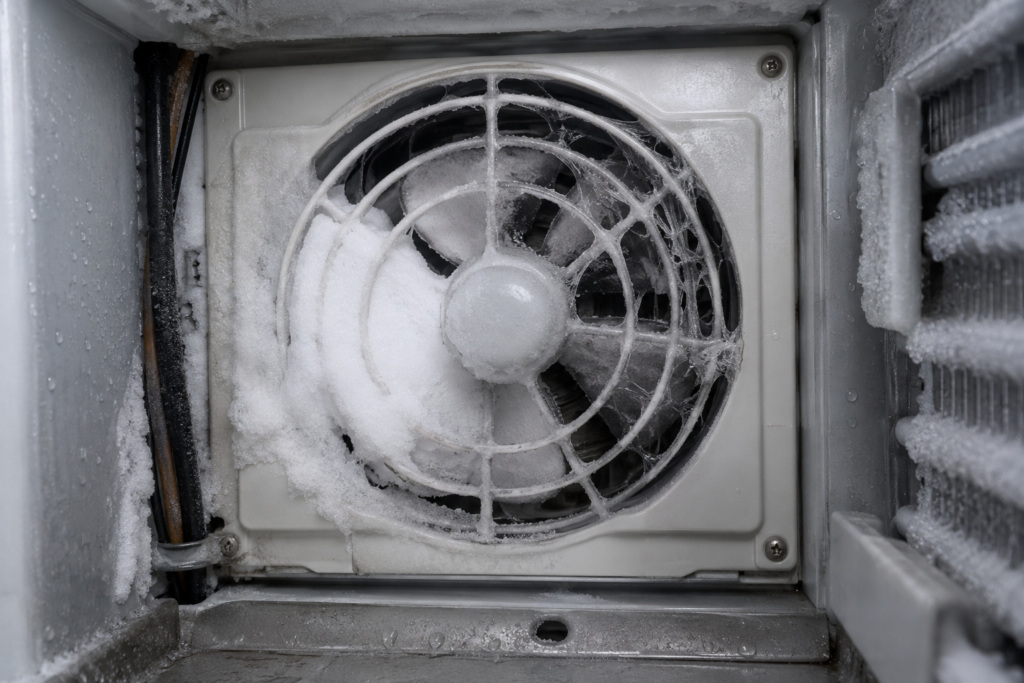
- Look for ice or debris — unplug the unit and check the evaporator fan area for ice and the condenser fan area for leaves or obstructions. If ice has blocked the evaporator fan, run a full manual defrost before testing further.
- Try the blade by hand — a blade that spins freely points at a failed motor, and one that is stiff or jammed points at an obstruction or a seized bearing.
The page also lets you try a reset: unplug the unit for five minutes and restore power, which may restart a fan that was stalled by a temporary obstruction. If it still does not run, the motor or wiring has failed.
Why Do Outdoor Fans Fail Sooner?
The page says outdoor fan motors are more vulnerable to age, heat and moisture than indoor equivalents, and that wiring harnesses can corrode or be damaged by insects. Our service page for outdoor refrigerators adds that leaves, cottonwood and insects are the most common debris that foul the condenser area, and technicians clean it before evaluating any other component.
That has a practical consequence for the decision. If the fan failed because the unit sits in a dusty, humid or unshaded spot, a repair fixes the part and not the cause. Keep that in mind when you weigh the cost: a motor in the same spot will meet the same conditions. Our outdoor refrigerator maintenance guide covers the clearance and cleaning that protect the fans.
Fix or Replace: What Decides It
When you weigh a DCS outdoor refrigerator fan fix or replace, the answer is usually to fix it, provided the rest of the unit is sound. The FAN-FAIL page lists a typical repair from $250 and one to two hours of technician time, and it rates the job as one that is not do-it-yourself. The final price is confirmed after on-site diagnosis, with a written estimate before work begins.
What would tip the decision toward replacing the whole unit is a pattern, not the fan alone:
- Compressor trouble as well — a unit that has had a fan failure and a hard-starting compressor is showing general wear.
- Repeated fan failures — a second motor in a short time suggests the conditions, not the part, are the problem.
- Frost or water damage in the cabinet — an ice-blocked fan that burned out its motor may have damaged more than the fan.
- A board fault on top of a fan fault — the page lists a failed control board relay as a separate cause, and a board adds to the price.
It also helps to count what you would be giving up. A replacement means a new unit, a cabinet cut-out that must match, and a delivery and fitting job in an outdoor kitchen where access can be awkward. Put that beside a repair that takes an hour or two, and the fan on its own rarely justifies replacing the refrigerator. Keep the written estimate and compare it with the age and condition of the unit before you commit either way.
If none of those apply, repairing a premium built-in unit usually costs less than replacing it and the cabinet cut-out it sits in.
What a Technician Will Do and What to Do Meanwhile
Book the visit if the blade spins freely but the fan does not run, if there is no ice or debris, or if the fault returns right after you clear an obstruction. Those are the conditions the page gives for calling. Our outdoor refrigerator repair includes evaporator and condenser coil inspection, and the technician tests the fans, wiring and board in turn.
Until then, move food to another refrigerator. The site's temperature monitoring notice advises an independent thermometer and says condenser fan failure needs professional diagnosis. Stop using the unit at once if you smell burning from the fan area. For the wider no-cooling picture, see DCS outdoor refrigerator not cooling. When you are ready, book a visit or send us the model number and which fan is silent.