 Michael Torres
Key Takeaways
- DCS grill hot spots mostly come from uneven ceramic briquettes, a partly blocked burner, or a warped burner tube or seized valve.
- Compare flame heights across the burners at dusk, and use a hand held about six inches above the grate.
- Spread the briquettes evenly, remove cracked or greasy ones and replace the full set every two to three seasons.
- Clear blocked ports with a straightened paper clip, working along the entire burner.
- Call a technician when uneven heat persists, a valve feels stiff or a burner tube looks damaged.
The Bottom Line
Redistribute the briquettes and clear the burner ports on a cold grill. If one burner is still weak, or a valve feels stiff, book a diagnosis.
DCS grill hot spots show up as steaks that finish in different places at different times, one side of the grate scorching while the other stays pale. A grill like this is built to spread heat evenly, so when it does not, something in the heat path has changed. DCS grills use a layer of ceramic briquettes above the burners to turn direct flame into radiant heat across the cooking surface, and most uneven cooking traces back to that layer or to a burner that is no longer putting out what its neighbors do. The good news is that the first fixes are cheap and need only a cold grill and a few minutes.
| What you notice | Likely cause | Who usually fixes it |
|---|---|---|
| Food cooks at different rates across the grate | Shifted, cracked or grease-soaked briquettes | You |
| One burner shows a lower flame than the others | Partly blocked burner ports | You, with a straightened paper clip |
| One grate section scorches while another stays pale | Uneven briquette loading or a weak burner | You first, then a technician |
| One burner will not give full output or its valve feels stiff | Warped burner tube or a seized valve | A technician |
What Causes Hot Spots on a DCS Grill?
Three things cause nearly all of them, and two are within an owner's reach. This site's hot spot code page lists them in order of how often they turn out to be the answer.
- Uneven briquette or flame tamer loading — ceramic briquettes that have shifted, cracked or soaked up grease stop spreading heat evenly.
- A partly clogged burner — blocked ports on one burner put out less heat than the burners beside it, which leaves a cooler stripe across the grate.
- A warped burner tube or seized valve — a damaged U-shaped burner or a valve that will not open fully reduces output from one burner.
Hot spots are not a safety problem in themselves. The site says the grill is safe to use, but the cooking will be inconsistent, and that rotating food and using indirect zones can partly compensate until the grill is fixed.
How Do You Find a Hot Spot on a DCS Grill?
Look at the flames, then test with your hand. With the grill cold, tidy the briquettes. Then light every burner and set them all to the same position. Looking through the grate, compare the flame height from each burner. Any burner that is noticeably lower than the rest has partly blocked ports. The code page recommends doing this at dusk or in low light, because the differences in flame height are much easier to see.
A second test is the hand test. Hold your palm about six inches above different areas of the grate and compare the heat. A dramatic difference between zones that should be identical points at the same two suspects. Keep your hand moving and well above the flames.
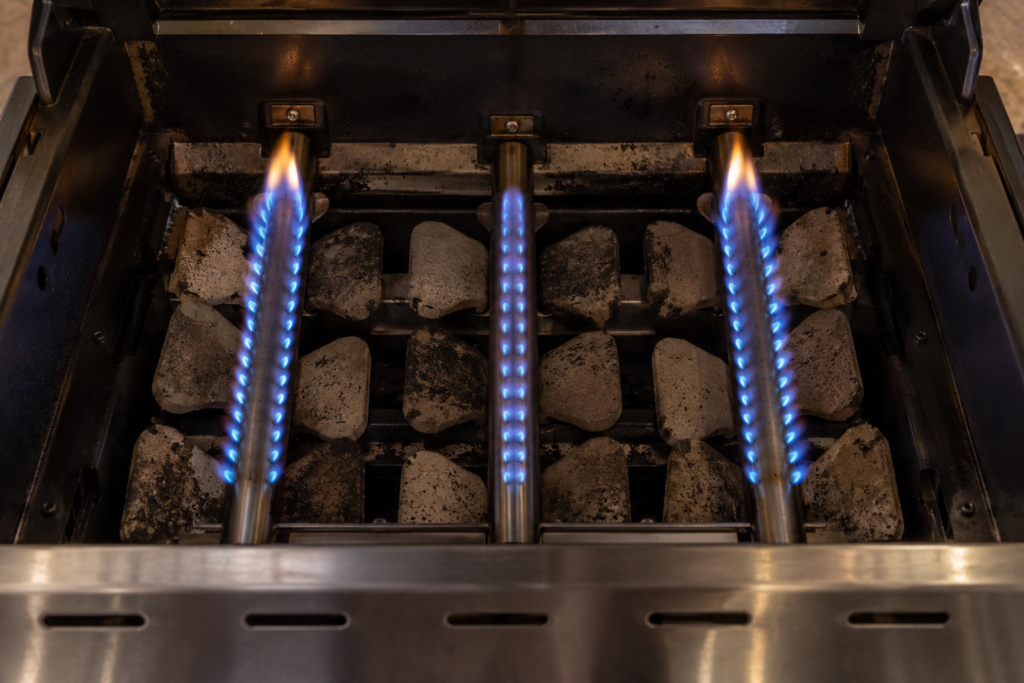
Redistributing the Briquettes
Start here, because it is free and it is the first thing the code page tells you to do. Wait until the grill is cold and the gas is off, remove the grates and look at the briquette arrangement.
- Spread the briquettes evenly across the tray so no area is bare and none is piled.
- Remove any that are cracked or saturated with grease, since they no longer radiate heat properly.
- Flip them grease-side down from time to time, so burner heat can burn off the residue on its own.
- Replace the full set every two to three seasons, as the code page advises.
Heavy grease buildup on the tamers is also a flare-up risk, and the code page lists it as a reason to stop and clean before cooking again.
Clearing Blocked Burner Ports
If one burner shows low flames, clear its ports. With the grill cold and the gas off, use a straightened paper clip to clear each port along the burner tube that is showing low flames, then brush away the debris and retest. The page says to work along the entire length of the burner, because a single blocked port can unbalance the flame pattern.
Do not widen the ports or use a drill bit. The paper clip is deliberate: it clears what is in the hole without changing the hole. The routine is part of keeping a grill healthy, and our guides to DCS grill maintenance and how to clean a DCS grill cover it in more detail.
Cooking Around a Hot Spot Until It Is Fixed
Because the grill is safe to use, you do not have to stop cooking while you wait for a visit. The code page suggests working with the uneven heat, and a few habits make that easier.
- Rotate the food halfway through, and move pieces from the hot zone to the cooler one.
- Use the cooler zone as an indirect area for thick cuts that need to finish gently.
- Keep thin or delicate items away from the zone that scorches.
- Check doneness by feel and thermometer instead of by the clock, since timing will not hold across the grate.
The exception is a grill that develops heavy grease buildup on the tamers. That is a flare-up risk, so clean it before you cook rather than cooking around it.
What a Hot Spot Is Not
Uneven heat is different from a few other grill complaints that sound similar, and mixing them up sends you to the wrong fix. Check the list before you settle on a cause.
- A grill that runs too hot everywhere is an overheating question, which the site covers on its own TEMP-HIGH page, and it should be checked against a thermometer on the grate.
- Large, persistent flare-ups are grease and fat, and they have their own FLARE-UP page.
- A burner that does not light at all is an ignition fault, not an imbalance.
If you see one burner producing no flame while the others run, treat that as a fault to book rather than a hot spot to cook around.
When Should You Call a Technician About Uneven Heat?
Call when uneven heating persists after you have redistributed the briquettes and cleared the ports. The code page lists three other triggers: a burner valve that feels stiff or does not click through its full range, visible physical damage to a burner tube, and one burner that produces no flame at all while the others run normally.
Those point at a warped burner or a seized valve, and both involve gas components that are not a home repair. A hot-spot repair starts from $150 according to the site's code page, and the final price is confirmed after diagnosis on site, with a written estimate before work begins.
Tell the technician which burner is weak, what the flames look like, and what you have already cleaned. Our grill repair service covers burners, valves and ignition. If the grill will not light at all, start with our guide to a DCS grill that won't ignite, and for repair costs across the grill see DCS grill repair costs. When you are ready, book a visit or send us the model number and a description of the flames.