 Michael Torres
Key Takeaways
- SIDE-FAIL means the side burner module has failed to ignite reliably — a separate circuit from the main grill.
- The main grill remains safe to use normally as long as the side burner valve is fully closed, not left partly open.
- Insect nests in the venturi tube are one of the most common causes of a side burner that sparks but will not light.
- A gas smell around the side burner at any time means shutting the whole cart down until it is inspected.
- Repairs start from $150 for an igniter or port cleaning, more if the module itself needs replacing.
The Bottom Line
A failed side burner is almost always an isolated, low-cost repair — clean the ports, check for nests, and shut the valve fully if it will not stay lit.
DCS grill side burner failure shows up as one burner on the side shelf that will not light or will not stay lit, while the main grill keeps working normally on the other side of the cart. This site's SIDE-FAIL error page documents it directly, and because the side burner runs on its own gas line and its own igniter, most side burner failures are a small, isolated repair rather than a sign of trouble with the grill as a whole.
| Symptom | Likely cause | What to check first |
|---|---|---|
| Side burner will not spark at all | Failed igniter or a disconnected spark wire | Listen for a clicking sound when you press ignite |
| Sparks but gas does not light | Clogged burner port or a closed gas valve | Check the valve position and clean visible port openings |
| Lights, then goes out immediately | Failed thermocouple or flame sensor | Hold the knob in a few seconds longer after lighting |
| Weak, uneven flame around the ring | Partially blocked burner ports | Inspect the ring for debris or insect nests |
What Does the SIDE-FAIL Error Mean on a DCS Grill?
SIDE-FAIL means the side burner module has failed to ignite reliably, and the fault is reported by this site as a side burner failure specific to that module, not the main grill. Because the side burner has its own gas supply, its own igniter and its own control knob, this fault is mechanically separate from anything happening on the main cooking grates.
That separation is good news for most owners: a side burner that will not light rarely means the whole cart needs attention, and it almost never means the main grill's gas supply is compromised.
- No click at all when pressing ignite points at the igniter itself or a disconnected spark wire.
- A click with no spark visible at the electrode suggests a cracked ceramic collar on the igniter.
- Sparking normally but no gas smell when the valve is opened points at the valve or supply line, not the igniter.
Is It Safe to Keep Using the Grill If the Side Burner Fails?
Yes, the main grill remains safe to use normally when only the side burner has failed, provided you turn its gas valve fully off rather than leaving it in a partially open position. The one exception is a side burner that lights briefly and then goes out with the knob still open — in that case, gas may still be flowing without a flame, and the valve should be shut immediately rather than re-attempted repeatedly.
A grill with a smell of gas around the side burner area at any point, lit or not, should be shut down entirely at the main tank or supply line until it has been inspected, regardless of whether the main burners are working fine.
It is worth checking the main burners independently once the side burner is confirmed isolated, simply to rule out a shared gas manifold issue, though on nearly all DCS grill carts the side burner runs off its own dedicated line from the tank rather than sharing one with the main grates.
Why Do Side Burners Fail More Often Than Main Burners?
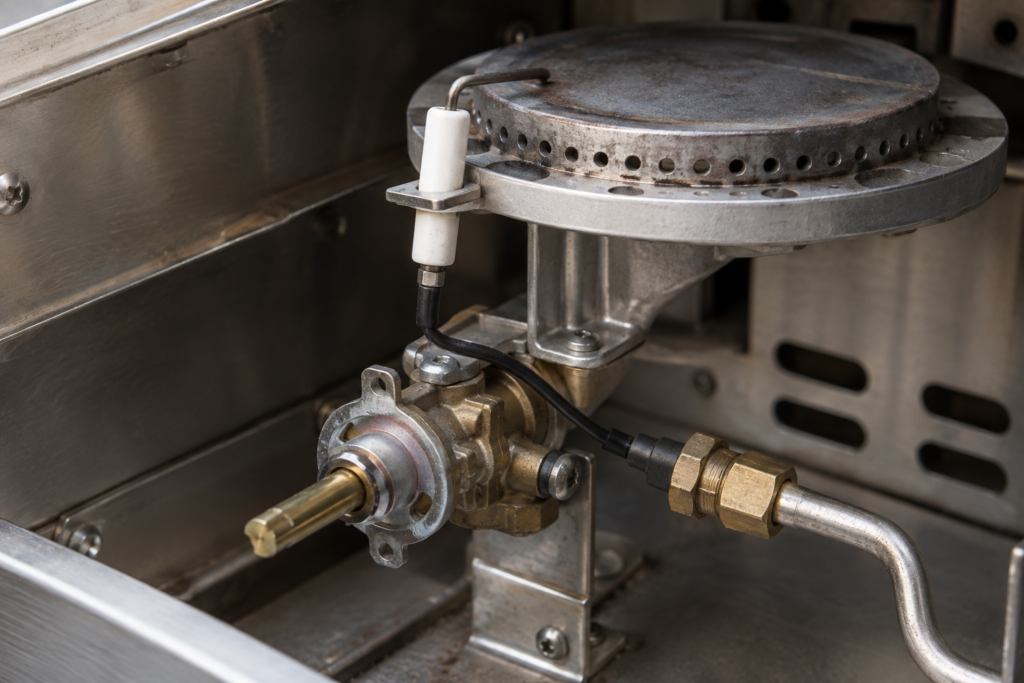
Side burners fail more often than main burners mainly because they are used less frequently and sit exposed to weather on an open cart, so their igniters and ports collect moisture, insects and debris between uses in a way that a main burner running weekly does not. Spiders in particular are drawn to the residual gas scent in an unused burner tube and can build nests that block the ports completely.
- Infrequent use lets corrosion and debris build up unnoticed between the rare occasions the burner is lit.
- Insect nests in the venturi tube are one of the single most common causes of a burner that sparks but will not light.
- Weather exposure on an open cart accelerates igniter wear compared with a burner protected under a hood.
- A knob left slightly open after a failed light attempt lets gas continue flowing without ignition, which is a hazard rather than a mechanical fault.
- Cold weather can make an already-weak igniter spark less reliably, which is why some owners only notice the fault seasonally.
None of this means a side burner needs replacing preventively on a schedule — it means the checks below are worth doing at the start of the outdoor cooking season, before the burner is needed for a backyard gathering rather than in the middle of one.
DIY Checks Before Calling a Technician
- Turn the gas off at the tank and let any residual gas clear for a few minutes.
- Remove the burner cap and clean visible port openings with a soft brush, not a wire tool that can widen the holes.
- Check for spider webs or debris inside the venturi tube leading to the burner.
- Reconnect the gas, relight from a safe distance, and confirm the flame is even around the full ring.
How Much Does It Cost to Fix a SIDE-FAIL Error?
Repairs for a SIDE-FAIL error start from $150 for an igniter or a cleaned and cleared burner port, which covers the majority of side burner complaints on this cart style. A full side burner module replacement, needed when the burner itself has corroded through, costs more and is confirmed only after a technician has inspected the part.
A diagnostic visit starts from $89 and is worth booking whenever a basic cleaning does not resolve the fault, since guessing between an igniter and a full module swap from the symptom alone is unreliable.
Most owners find the cleaning and inspection steps above resolve the fault without any parts cost at all, which is why booking a diagnostic before assuming a part is needed tends to save money rather than add to the bill.
Booking a Repair
Our grill repair service covers the side burner igniter, valve and module along with the main grill it sits beside, and a technician can usually confirm and fix a SIDE-FAIL fault in a single visit. If the grill itself is also giving you trouble beyond the side burner, our guide to a DCS grill that won't ignite covers the main burner side of the same cart, and our DCS grill safety guide covers the broader precautions worth knowing around any grill repair. Schedule a visit or tell us which burner is affected so the right part is on the van.
Most side burner repairs are completed on the same visit as the diagnostic, since the parts involved are small and commonly carried on the van, which keeps this one of the faster fixes among the outdoor kitchen faults this site covers. Compare that with a fault requiring a special-order part for an older or less common cart model, where a follow-up visit is more likely simply because of parts availability rather than the difficulty of the repair itself.