 Michael Torres
Key Takeaways
- The door is the largest opening in the oven cavity, and a seal that has hardened at one corner makes the element run longer to cover the loss.
- The site keeps a separate entry for a door that is not sealing (DOOR-ERR), repair from $150.
- A hardened or displaced gasket is something an owner can find in five minutes with a cold oven and a sheet of paper.
- An uneven gap along the top edge means a hinge, not a gasket — and hinges are replaced in pairs, not improvised.
- Do not run self-clean on an oven whose door does not seal: that heat goes into the surrounding cabinetry.
The Bottom Line
Check the gasket and the door gap before anyone prices an element or a control board. A leaking door explains long preheats, uneven baking and a hot cabinet front, and it is one of the cheaper repairs on a built-in oven.
A wall oven that bakes unevenly, runs long, or lets heat out onto the cabinet front is usually blamed on the element or the thermostat. On a built-in unit the door is at least as likely, and it is the part almost nobody checks. The site keeps a separate entry for it — DOOR-ERR, door not sealing, with repair from $150 — and a DCS wall oven repair that starts at the door often ends there.
| What you notice | Most likely cause | Where to start |
|---|---|---|
| Heat escaping at the top of the door | Gasket hardened or pulled out of its channel | Inspect the gasket corner by corner |
| Door sits crooked or will not close square | Hinge worn or sprung | Check both hinges for equal travel |
| Door will not latch, or stays locked | Latch assembly or motorized lock | Book a diagnostic |
| Bakes fine on top, pale underneath | Heat loss plus an element or sensor fault | Rule the door out first |
| Cabinet front hot to the touch | Seal leaking around the frame | Stop using self-clean until checked |
| Oven runs long and never reaches setpoint | Sensor, element, or a leaking door | Diagnostic covering all three |
The Door Is Part of the Heating System
An oven does not hold temperature because the element is strong. It holds temperature because the cavity keeps the heat it makes, and the door is the largest opening in that cavity. A seal that has gone hard at one corner leaks continuously, and the control responds the only way it can: by running the element more often and longer. You get longer preheats, uneven browning, a hot cabinet front, and higher energy use, none of which look like a door problem from the outside.
On a wall oven this matters more than on a range, because the unit is enclosed by cabinetry on three sides. Heat leaking out the front has nowhere useful to go, and the cabinet face above and beside the door takes it. Owners often describe this as the oven "running hot" when the cavity is actually struggling to stay at temperature.
Checking the Gasket Yourself
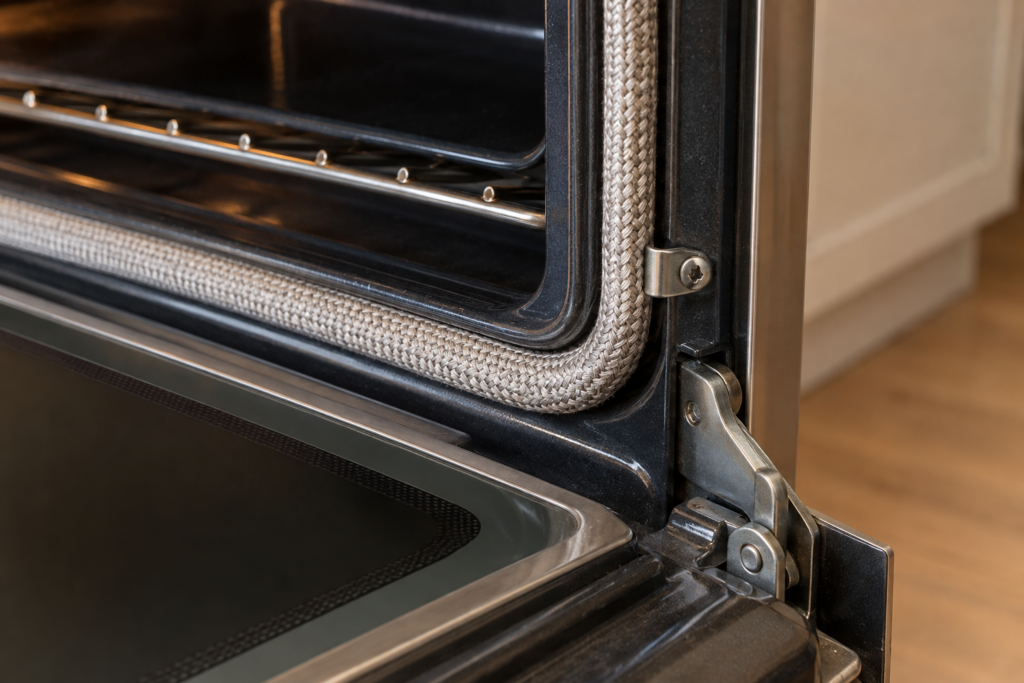
This part is an owner job, and it takes five minutes with a cold oven. The gasket is the braided rope seated in a channel around the door opening or the door itself.
- Run a finger along the whole length. It should be springy. Sections that feel hard, flattened, or brittle no longer seal.
- Look for a gap at the corners. Gaskets pull out of their clips at the corners first, and a short section standing proud of its channel leaks as badly as a missing one.
- Do the paper test. Close the door on a sheet of paper at several points and pull. Even resistance all the way around is what you want.
- Watch a preheat from the side. With the kitchen lights low, heat shimmer above the door edge shows you exactly where the leak is.
- Do not stretch a gasket back into place. A gasket that has pulled out has usually shrunk, and stretching it leaves a thin spot that leaks anyway.
When It Is the Hinges, Not the Seal
Wall oven doors are heavy and their hinges carry that weight through thousands of cycles. When one hinge wears or springs, the door stops closing square, and no gasket will seal a door that is not sitting flat. The tell is geometry rather than feel: look at the gap between the door and the frame along the top edge. It should be the same at both ends.
A door that drops when opened, closes with a thump, or needs a push at one corner to latch is telling you the same thing. Hinges are replaced in pairs for a reason — the second one is the same age as the first — and this is not a repair worth improvising, because a door coming off a partly engaged hinge is heavy enough to cause injury.
Latch, Lock, and Self-Clean
The latch is a separate mechanism from the hinges, and on models with a motorized lock it is tied into the control. A door that will not latch, or one that locks and refuses to release, should not be worked around by forcing anything. Self-clean is where this becomes a safety matter: the cycle runs at temperatures that require the lock to be intact and the seal to be sound, and a leaking door during self-clean puts that heat into the cabinetry.
If the door does not seal properly, skip self-clean until it is fixed. Our guide to DCS oven self-clean safety explains what the cycle demands of the door and when to avoid it altogether.
Ruling Out the Rest
Once the door is sound and the oven still misbehaves, the usual suspects come back into play. A temperature sensor reading wrong makes the control heat to the wrong number; the site lists a shorted sensor as F3, from $250, and treats it as a stop-using condition. A failing bake element, a weak igniter on a gas model, or a control board fault produce their own patterns.
- Inspect the gasket and the door gap before assuming anything electrical.
- Note what bakes wrong, and where in the cavity — top, bottom, front, back.
- Time a preheat and write the number down; it is the most useful thing you can hand a technician.
- Write down any code exactly as it appeared before clearing it.
Getting It Fixed
Gaskets, hinges, latches, sensors, and elements are all serviceable on a built-in oven without touching the cabinetry, which is the part owners most fear. A diagnostic starts from $89 and covers the door, the heating circuit, and the control as one job rather than a guess at the cheapest part. Our oven repair service handles the whole list, and our oven repair cost guide sets out what each tier involves.
The final price is confirmed after the on-site diagnosis, and you get a written estimate before any work begins. Book a visit and bring the preheat time and the baking pattern with you — those two details usually narrow it down before the panel comes off.