 Michael Torres
Key Takeaways
- A burner repair on a DCS gas cooktop starts from $150, and an electronics fault such as F1, F3 or F4 starts from $250.
- Replacing the whole burner is rare; the usual failures are the igniter electrode, the orifice, the module and the valve.
- A wet, dirty or crooked burner cap causes many no-light faults and costs nothing to clear.
- If every burner is weak, the gas supply pressure may be the cause, and that is a question for the gas utility.
- The final price is confirmed after on-site diagnosis, with a written estimate before work begins.
The Bottom Line
Clean the electrode, reseat the cap and clear the ports first. If the burner still fails, expect a diagnosis before any final price.
Owners who ask what it costs to replace a burner on a DCS gas cooktop are usually picturing the burner itself coming out and a new one going in. In practice that is rarely the job. On a DCS CPU-366 or CPU-486 cooktop the burner cap and base seldom wear out, and the parts that fail are the igniter electrode, the orifice that meters the gas, the ignition module and the valve behind it. Which of those it is decides the bill, and most of the time you can narrow it down before anyone arrives.
| What the burner does | What is usually fixed | Starts at |
|---|---|---|
| Clicks but will not light, worse on humid days | Igniter electrode cleaned, dried or replaced | from $150 |
| Lights but the flame is weak | Ports cleaned, orifice cleaned or replaced | from $150 |
| Keeps sparking when no burner is on | Wet electrode or ignition switch dried and tested, or the switch replaced | from $150 |
| F1 on the display | Ignition module diagnosed and replaced | from $250 |
| F3 or F4 on the display | Flame supervision or gas valve circuit | from $250 |
What Is the DCS Gas Cooktop Burner Replacement Cost?
It starts from $150 when the fault is in the burner area, and from $250 when the fault is in the electronics behind it. Those are the figures this site gives on its code pages for the no-ignition, weak-flame and click-without-ignition faults at the lower level, and for the F1, F3 and F4 codes at the higher one. The final price is confirmed after a technician has diagnosed the cooktop on site, with a written estimate before work begins.
A genuine whole-burner replacement is the exception. When the cap or base is cracked, corroded or warped, a part is ordered and the job takes longer, but nothing on the code pages points to that as the usual cause of a burner that will not work.
Which Part Is Actually Failing?
The behavior of the burner tells you most of the story, and each behavior points to a different part with a different price.
- Wet or dirty igniter electrode — moisture, grease or food debris on the ceramic electrode weakens the spark below what is needed to light the burner. This is the cheapest cause and a homeowner can often clear it.
- Misaligned or clogged burner cap — a crooked cap sends gas away from the electrode, and even a tilt of a millimeter can be enough. No part is needed at all.
- Cracked or eroded electrode — a hairline crack in the white ceramic, or a worn tip, cannot be repaired, and it has to be replaced with the correct OEM part.
- Partly blocked orifice — the small fixed fitting beneath the cap that meters the gas has a partial blockage, which gives a weak flame and calls for burner disassembly.
- Ignition module or valve — electronics, not the burner, and they are where the higher price starts.
What Moves the Price Up or Down
Four things shift the final figure, and the first two are within your control.
- How much is cleaned before the visit. A cooktop with a dry electrode and clear ports lets the technician go straight to the real fault.
- Whether one burner or several are affected. A single dead burner points to that burner's electrode or orifice, while several together point to the module or the supply.
- Whether the code is on the display. A displayed F1, F3 or F4 is an electronics job, and the code pages put those on the higher starting price.
- Gas supply pressure. If every burner is weak, the cause may be the supply and not the cooktop, and that is a check for your gas utility, which costs nothing from our side.
Can You Cut the Bill Before Booking?
Yes, because the cheapest causes are the ones you can clear yourself, and clearing them can turn a service call into a five-minute job. Do these only with the cooktop cold and the gas off.
- Remove the burner cap and clean the electrode with a dry toothbrush or cotton swab, and let it dry completely. Do not use water on it directly.
- Reseat the cap so it sits flat, with its locating pin or notch aligned. Jiggle it gently, since it should not rock.
- Look at the electrode with a flashlight for hairline cracks or a worn tip.
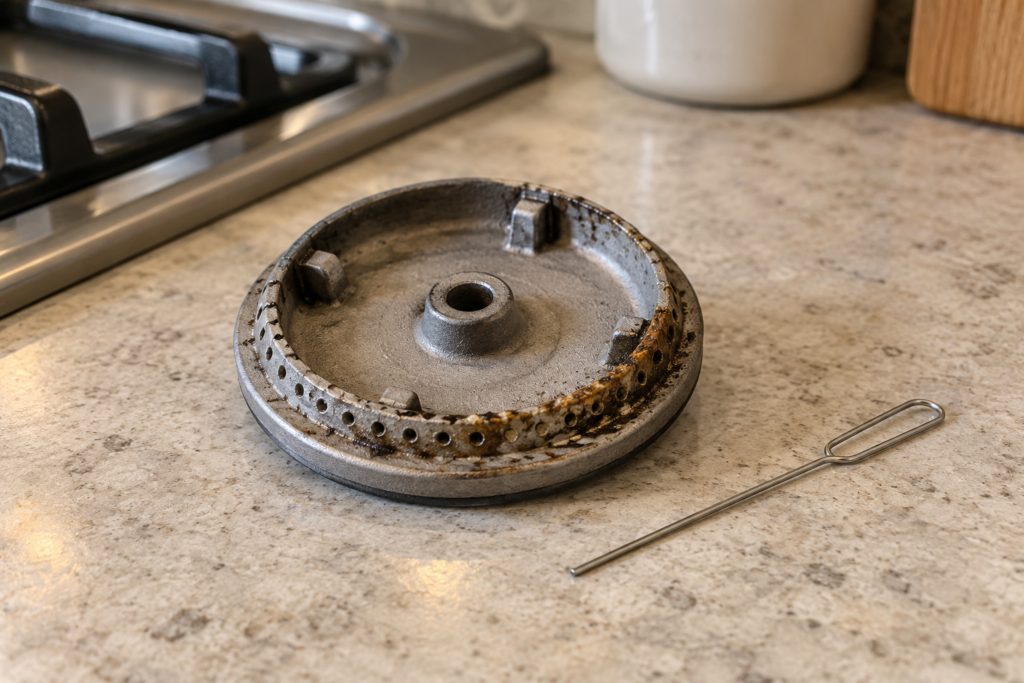
- Soak the cap and clear every port with a straightened paper clip if the flame is weak.
If the burner still will not light after that, you have documented the fault, ruled out the free causes and can describe the problem exactly. Do not keep trying to light a burner that clicks without a flame. Ventilate the kitchen, because the code page warns that unlit gas may have been released.
What the Visit Includes
Knowing what a technician actually does helps you judge an estimate. This site's cooktop repair page lists inspection of the sealed dual-flow burners and cleaning of their ports, a test of the igniter electrode and the spark module, diagnosis of the control board fault codes, and a check of burner output on these high-output cooktops. Gas connections that have been repaired are leak-tested before the visit ends, and the technician verifies gas pressure at the manifold before and after any repair.
That last step is the one that separates a repair from a guess. A burner that lights but runs weak can be a supply problem as easily as a burner problem, and a measured pressure reading settles it without replacing anything.
Is the Repair Worth It?
On a cooktop that is otherwise sound, a burner repair is almost always worth doing, because the cost sits far below the price of a new cooktop and the parts involved are small. The calculation changes when an electronics fault shows up on an old cooktop that has already had other repairs, and our worth-repairing guide for DCS cooktops covers that side of the decision.
Getting a Firm Number
The fastest way to a real price is to tell the technician which row of the table you are in. The no-ignition code page and the low flame page list the safe checks in order, and our DCS cooktop repair service tests the electrode, the module and the gas pressure on the same visit. For the wider cost picture, read the DCS cooktop repair costs guide.
One last point on timing. A burner that fails during a dinner party is a bad moment to start learning about igniters, so it is worth cleaning the electrodes and ports on all burners twice a year. It takes ten minutes, and it is the single habit that most often removes a burner fault from this table altogether.
The prices above are starting points, and the final cost is confirmed after the on-site diagnosis, with a written estimate before work begins. Book a visit or send us the model and what the burner does.