 Michael Torres
Key Takeaways
- A DCS rotisserie motor repair starts from $120, with the final price set after diagnosis on site.
- An overloaded or off-center roast is the commonest reason the motor stops, and it is not a failure.
- Many motors have a thermal cutout that resets after about 15 minutes of cooling.
- Cleaning the spit rod and coupling costs nothing and removes a common cause of stalling.
- A motor that hums but will not turn an empty rod, or keeps tripping at rated load, is the case that needs a replacement.
The Bottom Line
Run the motor with an empty rod first, then rebalance the load and clean the coupling. A motor that still hums or trips is worth a replacement quote, which starts from $120.
A DCS grill rotisserie motor replacement cost is worth working out before you buy anything, because a rotisserie that has stopped turning is very often not a dead motor at all. The usual culprit is the roast. A heavy or lopsided load makes the motor stall, and a stalled motor trips a thermal cutout that looks exactly like failure. Only when the rod turns freely and the motor still does nothing is a replacement on the table, and then the price depends on how the technician finds the fault. This guide sets out the site's own figures and the free checks that come first.
| What you notice | Likely cause | Cost note |
|---|---|---|
| Spit rod does not turn, empty rod turns freely | Overloaded or unbalanced food | No cost; reload and rebalance |
| Rod stalls, motor housing is hot | Thermal cutout tripped by the load | No cost; wait 15 minutes and lighten the load |
| Grinding or clicking while turning | Grease or debris in the coupling | No cost; clean and refit |
| Motor hums, empty rod does not turn | Seized or failed motor | Replacement, from $120 |
How Much Does a DCS Grill Rotisserie Motor Replacement Cost?
A rotisserie motor repair starts from $120, according to this site's rotisserie motor failure page, which puts the professional visit at 30 to 60 minutes. That is a starting figure, not a quote, and it only applies if the motor is the confirmed fault. The final price is confirmed after a technician has diagnosed the grill on site, and you get a written estimate before any work begins.
The page rates the fault low severity, which is why the starting price is among the lower figures for grill work. A rotisserie motor does not affect the main cooking surface. The grill can be used normally while the motor is looked at.
Is the Rotisserie Motor Really Dead or Just Overloaded?
Most of the time it is overloaded, and you can tell in two minutes without paying for anything. Take the food off the spit and run the motor with the empty rod. If it turns freely, the motor is fine and the load was too heavy or off-center. The code page is clear that an unbalanced load stresses the motor more than a heavy but centered one does.
- Remove the food and run the empty rod to see whether the motor turns it freely.
- Rebalance the load using both rotisserie forks, with the mass of the food centered on the rod.
- Try a lighter cut if the roast is near the motor's rated weight, since exceeding it makes the motor stall or overheat.
- Wait about 15 minutes if the motor has stopped, because many rotisserie motors have a thermal cutout that resets once they cool.
What You Can Fix for Nothing
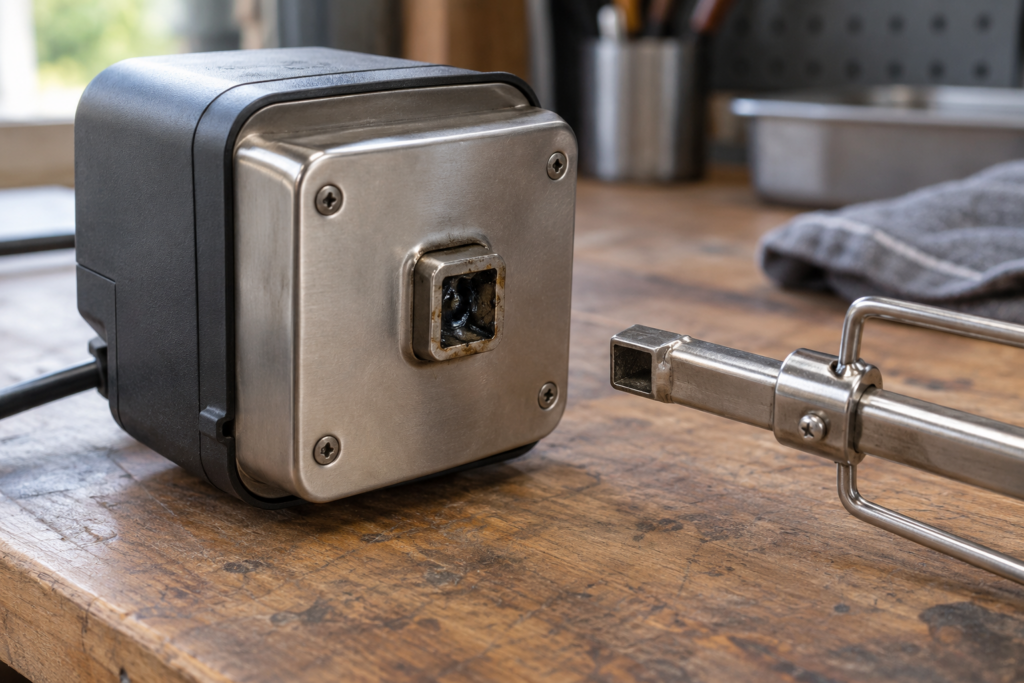
Before any part is priced, clean the connection between the rod and the motor. Grease on the spit rod, in the motor coupling socket or around the bracket mount can add enough drag to stall the motor, and the code page lists it as the second most common cause. Remove the spit rod and clean it thoroughly with degreaser, then wipe the coupling socket and bracket area with a dry cloth. When you refit the rod, check that it engages the coupling squarely, because a half-engaged rod gives the motor a poor lever and stalls it under load.
The motor is meant to turn the spit at a steady two to four turns a minute. If the rod now turns in jerks, or stops partway through a cook, it has either too much load or too much drag, and neither needs a new motor.
Signs That Point to a Failed Motor
If the checks above change nothing, the motor itself is the suspect. The code page names three situations where it says to call a professional, and they are the ones that justify a replacement quote.
- The motor hums but the empty rod does not turn — power reaches the motor and the shaft will not move, which suggests a seized motor.
- Grinding persists after cleaning the coupling and rod — internal bearings may be worn.
- The thermal cutout keeps tripping at the rated load — the motor is overheating when it should not be.
Stop at once if you smell burning or see smoke from the motor housing, or if the housing is hot after a short run. Switch it off and leave the motor alone until it has been checked.
Habits That Keep the Motor Alive
A replacement motor is only worth fitting if it is not about to meet the same treatment that stalled the first one. Four habits cover what the code page identifies as the usual stress on the drive.
- Stay under the rated weight and choose a smaller roast over pushing the limit with a large turkey.
- Use both forks and center the food so the weight sits evenly around the rod.
- Seat the rod fully in the coupling before you switch the motor on.
- Degrease the rod and coupling after greasy cooks, before the residue sets.
Doing this takes a minute and leaves the motor with an easier life. If a technician does replace it, tell them how the grill has been used so they can check that the coupling and bracket are not adding drag.
How the Price Compares With Other Grill Repairs
It helps to see where a rotisserie motor sits among the other repairs on the same grill. These are the starting prices listed on the site's own code pages, and each is confirmed after diagnosis.
- Rotisserie motor — from $120, for a low-severity fault with a 30 to 60 minute visit.
- Hot spots and a lid that will not seal — from $150, usually briquettes, ports or hinges.
- Excessive flare-ups, overheating and firebox corrosion — from $250, where visits run longer.
Our DCS grill repair costs guide puts the whole grill in one place, and the rotisserie sits at the cheaper end of it.
Is a DCS Rotisserie Motor Worth Replacing?
If you use the rotisserie, yes, as long as the rest of the grill is in good shape. The motor serves one function, so the question is whether you want that function and whether the grill around it has years left. Our is a DCS grill worth repairing guide covers the larger decision. If the grill also has firebox corrosion or a lid that no longer seals, add those repairs up before you commit to a new motor, and read DCS grill repair or replace so the motor is judged as part of the whole grill and not on its own.
Tell the technician what the motor does when you switch it on, whether the empty rod turns, and whether the cutout has tripped. Our grill repair service covers rotisserie motors along with burners and ignition. When you are ready, book a visit or send us the grill model and a description of the problem.