 Michael Torres
Key Takeaways
- Outdoor conditions kill the airflow parts and the door seal long before they touch the compressor.
- A blocked grille or a packed condenser coil explains a large share of "it will not stay cold" calls and costs nothing to rule out.
- Fan, gasket, thermostat and light repairs start from $150; sealed-system and control board work starts from $250.
- A compressor that clicks without starting is often the relay, not the compressor — have it measured before you price a replacement.
- Photograph the model and serial plate before ordering anything: outdoor cabinets rarely take the indoor part.
The Bottom Line
On a DCS outdoor refrigerator the cheap parts fail first and the expensive ones usually fail because a cheap one was ignored. Clear the grille and check the gasket yourself, then book a diagnostic if the cabinet still drifts warm.
People searching for DCS refrigerator parts are almost never collecting spares. They are standing in front of an outdoor refrigerator that has stopped holding temperature, and they want to know which part is involved and what it is going to cost before anyone comes out. The good news is that the list of parts that actually fail on these units is short, and the difference between the cheap end and the expensive end is easy to tell apart from the symptoms.
| Part | What you notice | Repair |
|---|---|---|
| Condenser fan motor | Cabinet warms on hot afternoons, compressor runs on | from $150 |
| Door gasket | Sweating around the frame, frost inside, warm top shelf | from $150 |
| Thermostat or temperature sensor | Temperature swings with no pattern | from $150 |
| Interior light and switch | Light stays dark, or stays on with the door shut | from $150 |
| Evaporator fan | Uneven cooling, noise that rises and falls | from $150 |
| Compressor or sealed system | Clicking, no cooling at all, warm cabinet | from $250 |
| Control board | Dead display, settings that will not hold | from $250 |
Why These Parts Wear Faster Than Indoor Ones
An outdoor refrigerator does the same job as the one in your kitchen while facing conditions the kitchen unit never sees. Ambient air on a covered patio in August can sit well above what any refrigerator is designed to reject heat into. Humidity condenses on cold surfaces every time the door opens. Pollen, lawn clippings, and dust settle into the condenser coil in a season instead of a decade. On a coastal property, salt in the air adds corrosion to all of it.
The result is predictable: the parts that move air and the parts that seal the cabinet do most of the dying. Compressors on these units are generally robust, and when one does fail, it usually failed because something upstream made it work far harder than it should have for a long time. That is why an airflow problem caught early is the cheapest repair on this whole list, and the same problem ignored for two summers becomes the most expensive one.
The Airflow Parts Fail First
If the cabinet cools fine in the morning and drifts warm by mid-afternoon, look at airflow before anything else. The condenser sits behind the lower grille, and it needs a clear path for air to come in, cross the coil, and leave. Built-in installations make this fragile: the grille is close to the ground, the cavity is enclosed on three sides, and anything blocking either end starves the whole system.
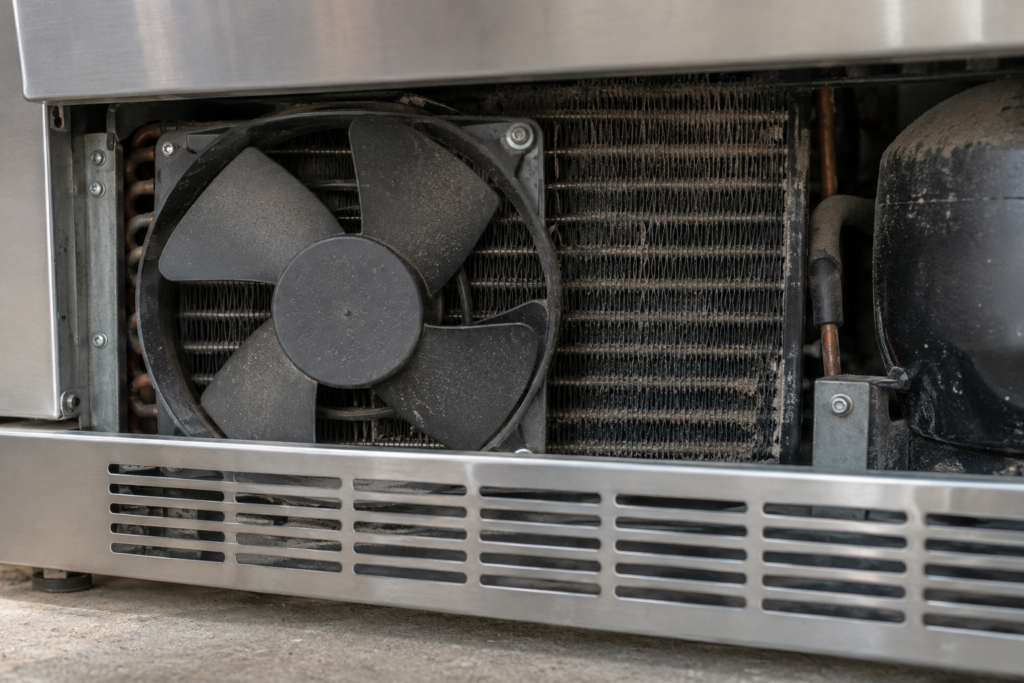
- Blocked grille. Leaves, mulch, and dryer-sheet lint from the nearest vent all collect there. Clearing it costs nothing and fixes a surprising share of complaints.
- Dirty condenser coil. A coil packed with dust cannot shed heat, so the compressor never cycles off. This is the failure that quietly shortens the life of everything behind it.
- Failed condenser fan motor. The site lists this one as FAN-FAIL, fan not running. The cabinet may still cool on a mild day and give up completely on a hot one.
- Evaporator fan. Inside the cabinet, this one moves cold air across the shelves. When it fails, the top of the cabinet goes warm while the bottom frosts.
Gaskets Are Cheap and Get Ignored
A door gasket on an outdoor unit takes ultraviolet light, heat cycling, and grease from the grill two feet away. It goes hard, then it stops making a continuous seal at one corner, and warm humid air leaks in around the clock. You see it as sweating on the frame, a wet shelf, or frost that keeps coming back after you wipe it away. The part is inexpensive and the work is quick, but the running cost of leaving it is real: the compressor runs far more than it should to make up the loss.
Check it the simple way. Close the door on a dollar bill at several points around the frame and pull. If it slides out freely at one spot and grips at the others, that spot is your leak. Our guide to outdoor refrigerator maintenance covers the seasonal routine that keeps both the gasket and the coil out of trouble.
When It Is the Sealed System
Two symptoms move the conversation into the expensive tier. The first is a compressor that clicks and does not start, which the site records as COMP-CLICK. That is usually the start relay or the overload protector rather than the compressor itself, and the difference is enormous, so it is worth having measured rather than assumed.
The second is a cabinet that never gets cold at all while the compressor runs continuously and the coil stays cool to the touch. That points at the refrigerant circuit, which is sealed work requiring certification. Sealed-system repairs start from $250 and go up with the model, and on a unit that is well past a decade of service they are the point where replacement deserves a serious look.
Before You Order a Part Yourself
Ordering parts on a guess is the most common way owners spend money twice. The model and serial plate is usually on the inside wall of the cabinet or behind the lower grille, and the part that matches the outdoor version of a cabinet is often not the part that matches the indoor one.
- Photograph the rating plate before you search anything. Model and serial together, in focus.
- Record the behavior, not the guess. When does it go warm, how long does the compressor run, is there frost anywhere.
- Clear the grille and coil first. If that fixes it, you have saved the whole call.
- Do not open the sealed system. Refrigerant work is not a do-it-yourself job and cannot be done without certification.
What a Visit Actually Costs
A diagnostic starts from $89 and covers the airflow path, the fans, the thermostat, the seal, and the compressor circuit as one piece of work rather than a look at the display. That matters here because the symptoms overlap so heavily: a weak gasket, a dirty coil, and a failing fan all read as "it does not stay cold."
The final price is confirmed after the on-site diagnosis, and you get a written estimate before any work begins. Our outdoor refrigerator repair service carries the common airflow and sealing parts on the truck, which is what turns most of these into one visit instead of two. Book a visit or send us the details and we will tell you which tier you are likely in before anyone drives out.