 Michael Torres
Key Takeaways
- The decision turns on which part failed, not on the age of the drawer.
- Seals, runners, fans and temperature sensing take the stress in a drawer and are all component repairs, from $150.
- A drawer that no longer closes flush cannot seal, and this is the failure most often mistaken for a refrigeration fault.
- Replacement drags the surround into it: the opening, the supply, and the ventilation clearances were built around the old unit.
- Sealed-system failure, corrosion through the cabinet, repeat failures in one season, or unobtainable parts are the four cases where the answer turns to no.
The Bottom Line
If the drawer still makes cold, the repair is almost always worth doing, because replacing a built-in drawer means work on the surround as well as a new unit. A sealed-system failure is the one case that genuinely changes the answer.
A refrigeration drawer is a different proposition from a refrigerator, and that shows up the moment something goes wrong with it. A DCS CoolDrawer repair is rarely a question of whether the part exists — it is a question of whether a drawer built into a run of cabinetry, and often into an outdoor island, is worth keeping alive. The answer depends far more on which part failed than on how old the unit is.
| What failed | How it shows up | Usual outcome |
|---|---|---|
| Door or drawer seal | Sweating, frost, contents warm at one end | Repair, from $150 |
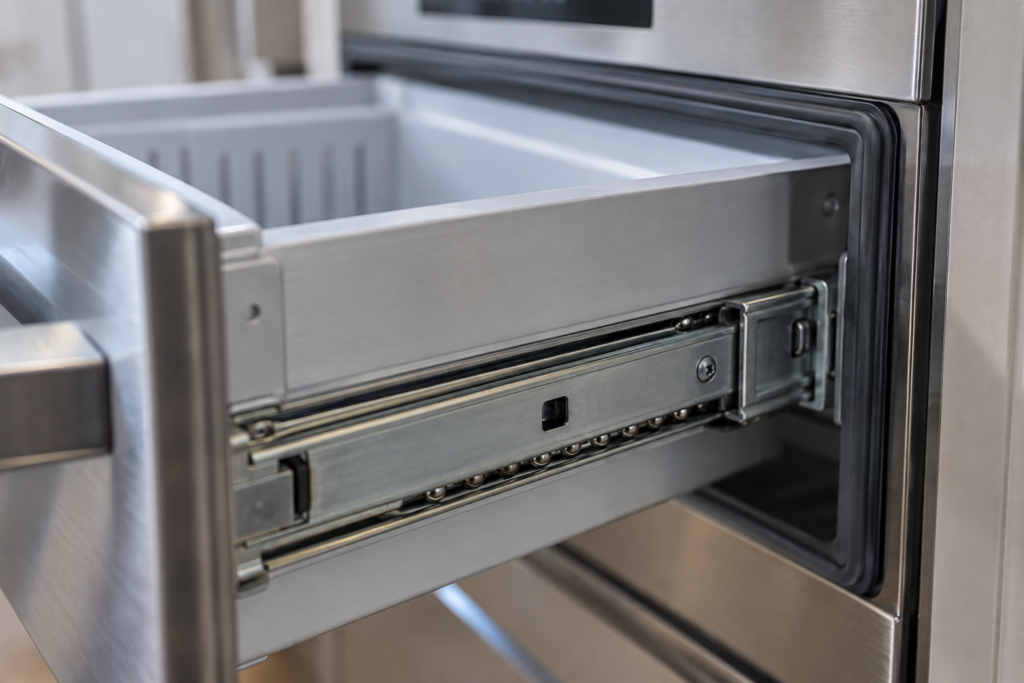
| Drawer runners and alignment | Drags, sits proud, will not close flush | Repair, from $150 |
| Temperature sensor or control | Setting will not hold, swings between modes | Repair, from $150 |
| Evaporator or condenser fan | Noise, uneven cooling, warm on hot days | Repair, from $150 |
| Control board | Dead panel, mode changes on its own | Repair, from $250 |
| Sealed refrigeration system | No cooling at all, compressor running | Worth a hard look at replacement |
Why a Drawer Is Not Just a Small Refrigerator
Two things separate a refrigeration drawer from a cabinet. The first is that the cold volume moves: every time the drawer opens, the entire compartment is exposed rather than one wall of it, so the unit works harder per opening and the seal does more of the work. The second is that the drawer runs as a selectable-temperature compartment rather than a fixed one, which means the control and its sensing are carrying more responsibility than they would in a plain refrigerator.
Both facts push the repair decision in the same direction. Seals, runners, fans and sensing are the parts that see the stress, and all four are component-level repairs. The refrigeration circuit itself generally has an easier life than the one in an equivalent outdoor cabinet, which is why a drawer with a genuine sealed-system failure is often a unit with years of hard service behind it.
The Repairs That Are Clearly Worth It
Most calls on these drawers land in the inexpensive tier, and the symptoms overlap enough that guessing is a waste of money. The pattern to look for is whether the unit is failing to keep cold in, or failing to make cold at all.
- Seal. The site lists this failure for its refrigeration as DOOR-SEAL, door not sealing properly. Sweating on the face and frost inside both point here.
- Alignment and runners. A drawer that no longer closes flush cannot seal no matter how good the gasket is, and this is the failure people mistake for a refrigeration problem most often.
- Temperature swings. Recorded on the site as TEMP-FL. Sensing and control faults are measurable, not a matter of opinion.
- Fans. A fan that has stopped moving air produces warm contents while the compressor runs normally, and it is an inexpensive part.
- Lighting and switches. Cosmetic, cheap, and worth folding into another visit rather than calling out for on their own.
The Hidden Half of Replacing One
Replacement pricing on a built-in drawer is never the price of the drawer. The opening was cut for specific dimensions, the electrical supply terminates where it terminates, and in an outdoor island the surround is masonry rather than a cabinet you can unscrew. Ventilation clearances have to be respected on the replacement too, and they are not the same on every unit.
This is the arithmetic that keeps component repairs worth doing for a long time on these drawers. A seal, a runner set, a fan or a sensor is straightforward work against a replacement that drags the surround into it. The same logic runs through our guide on whether a DCS outdoor refrigerator is worth repairing.
Where the Answer Turns to No
There is a point where repair stops being sensible, and it is defined by the failure rather than the calendar. A sealed-system fault on a drawer — no cooling at all while the compressor runs — is the clearest case, because that is the most expensive assembly in the unit and the work requires refrigerant certification.
- Sealed system failure on a unit with long service behind it. Get it confirmed, then price both paths honestly.
- Corrosion through the cabinet on an outdoor installation. Structure is not a repair.
- Repeat failures in one season across unrelated parts, which says more than any single part does.
- Parts no longer obtainable for the specific unit — always worth checking before committing to a diagnosis-led repair.
Short of those four, a drawer that still makes cold is usually worth the component repair, especially when it is one of a matched run of units where a single replacement will not visually match anything.
What to Establish Before Deciding
Do not make this call from symptoms alone. The three questions that settle it are whether the compressor still cools, whether the cabinet and surround are sound, and whether the failed part is a component or the sealed system. A diagnostic answers all three, and it costs far less than a replacement bought on a guess.
Measure the behavior first. Put a thermometer in the drawer and note what it actually reads against what is set. Watch whether the problem tracks the weather — an outdoor drawer that is fine in the morning and warm at four in the afternoon is almost always telling you about airflow rather than the compressor. Note whether frost keeps coming back after you wipe it away, which points at the seal rather than at refrigeration.
Getting a Real Answer
A diagnostic starts from $89 and tells you which tier you are in, which is the only fact this decision actually needs. Our outdoor refrigerator repair service covers refrigeration drawers along with the cabinets, and a technician will say plainly when a unit is not worth the parts rather than selling you a repair that buys one season.
The final price is confirmed after the on-site diagnosis, and you get a written estimate before any work begins. Book a visit, or send us the model and the symptoms and we will tell you what is usually involved before anyone drives out.