 Michael Torres
Key Takeaways
- The most frequent cause of weak flames on a propane DCS grill is the regulator in safety bypass, not the burner.
- Clear blocked ports with a straightened paper clip, never a toothpick, before buying a burner.
- Pitting or holes in the burner tube, or a warped U-shape, are the real signs that a burner needs replacing.
- Replace a burner only if the firebox is sound; perforated firebox walls or floor point to replacing the grill.
- Do not use a grill with holes in the burner tube, and leave valve, manifold and regulator work to a technician.
The Bottom Line
Reset the regulator and clear the ports first. Replace the burner if the tube is pitted or warped and the firebox is sound, and book a diagnosis if one burner stays weak.
For a DCS grill burner worth replacing, look for three things: pitting or holes in the tube, a warped U-shape that gives an uneven flame, or low output on one burner after the ports have been cleaned. Anything short of that is a cleaning or a gas-supply job, and the cheapest fix is the first one. A burner is also one of the most replaceable parts on a grill, because it is not structural, so the real question is rarely the burner itself. It is whether the firebox around it is sound enough to justify the work. This guide covers the burner only; the grill as a whole belongs to our parent guide on whether a DCS grill is worth repairing.
| What you find | What it means | Replace the burner? |
|---|---|---|
| Every burner burns low | Regulator in safety bypass, or a low tank | No, reset the regulator first |
| One burner low, ports blocked | Grease and debris in the ports | No, clear the ports |
| Ports clean, one burner still weak | A faulty valve or a damaged tube | Diagnose before buying |
| Pitting or holes in the burner tube | Corrosion has gone through the metal | Yes |
| Firebox floor or walls perforated | The grill body is failing | No, weigh replacing the grill |
Is It Worth Replacing a DCS Grill Burner?
Yes, when the burner is the only thing that has worn out and the firebox is sound. Our parent guide says U-shaped burner replacement is worth doing on any grill with a sound firebox, precisely because burners are not structural components and the rest of a DCS grill is built to last far longer. The cost is rarely the obstacle. The obstacle is replacing a good burner when the fault was the regulator or a clog.
That is why the order matters. Work through the free checks, then decide on the burner, then look at the firebox.
Free Checks Before You Buy a Burner
The LOW-FLAME code page on this site names the most frequent cause of weak flames on a propane DCS grill, and it is not the burner: the LP regulator entering safety bypass when the tank valve is opened too quickly. Three safe checks come first.
- Reset the regulator. Turn every knob off, close the tank valve, disconnect the regulator, wait 60 seconds, reconnect and open the valve slowly.
- Check the tank level by pouring warm water down the side and feeling for the cold line. The page says to swap or refill below about 20 percent.
- Clear the ports with a straightened paper clip along the burner tube, then brush the debris away. Do not use a toothpick, which can break off and block a port.
How Do You Tell a Dirty Burner From a Dead One?
A dirty burner recovers after cleaning, and a dead one does not, so the test is simply to clean it and look again. With the grill cold and the gas off, run the paper clip along every port and compare the flame heights afterwards. If one burner is still lower than its neighbors with clean ports, the page lists a faulty individual valve as the likely reason, which is a gas-side repair and not a burner swap.
- Flame returns to normal after cleaning — it was blockage and the burner is fine.
- Only one burner is weak with clean ports — suspect its valve before the burner.
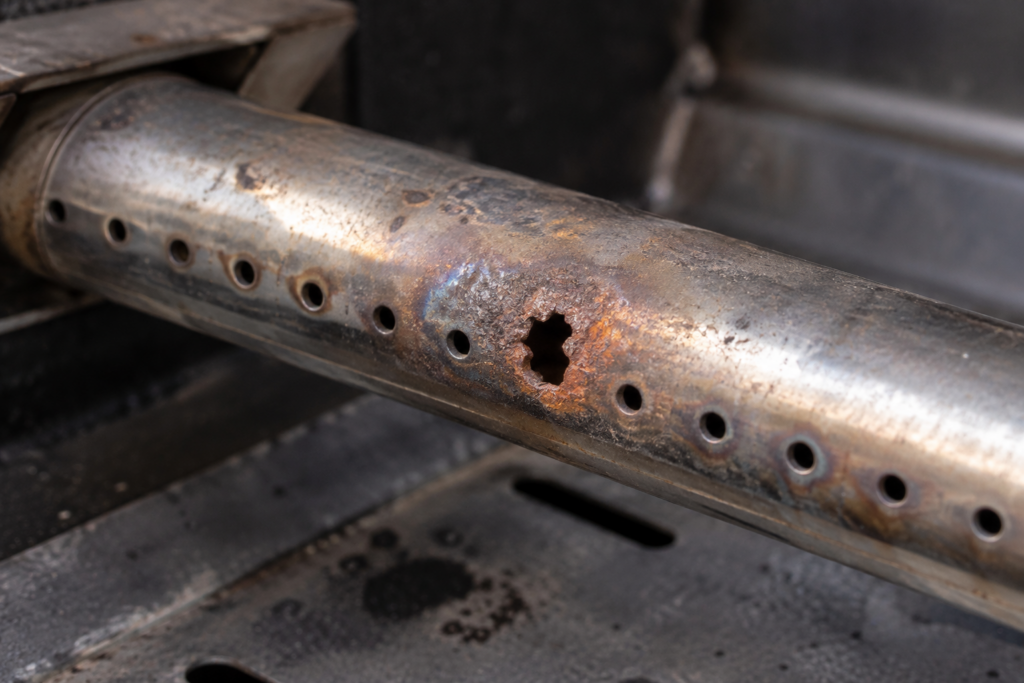
- Visible holes or pitting in the tube — the tube itself has failed and needs replacing.
- A bent or warped U-shape — the flame pattern will not even out, which our hot-spot page lists as a cause of uneven heat.
Signs a Burner Is Wearing Out
Burners fail slowly, and the early signs are visible a season or two before the burner stops working. Look at the burners at the start of the season, with the grates and radiant trays out and the grill cold.
- Orange rust staining or flaking on the tube, especially near the ports, where grease and moisture sit.
- Pitting along the tube, which our RUST-THRU page lists as a symptom alongside visible holes.
- A flame that is orange or yellow instead of blue with small yellow tips, which the YELLOW-FL page links to a blocked air shutter, an insect nest in the tube or a damaged tube.
- Gaps in the flame along the burner that do not fill in after the ports are cleared.
- A tube that has bent out of its original U-shape after years of heat.
Not all of these mean replacement. A yellow flame is often an air shutter with spider webs in it, and that is a cleaning job. The point of the inspection is to catch the damaged tube before it fails in the middle of a cookout.
When the Firebox Decides the Question
A new burner in a rotted firebox is money wasted. Our RUST-THRU page separates surface rust, which is cosmetic and cleans off, from rust-through, where the firebox floor or walls have holes. It treats a grill with perforations in the firebox as unsafe to use, and it lists burner tube pitting that has reached visible holes as a stop sign too.
Press gently on suspect areas of the firebox with the grill cold, and look at the cart frame as well. If the steel is soft, flexes or has holes, the burner is the least of the problems and the conversation moves to replacing the grill. If the firebox is clean, the burner is worth replacing. Our DCS grill repair or replace guide covers that wider decision.
Is It Safe to Keep Grilling With a Damaged Burner?
No, not if the tube has holes in it. The RUST-THRU page says to stop immediately if burner tube pitting has reached visible holes, since flame and heat can escape through unintended openings. A weak flame with intact metal is less urgent, and the low-flame page says the grill can be used cautiously at reduced capacity, but it also tells you to stop if all burners stay low after a regulator reset or if you smell gas at any point.
Gas work does not belong at home. Replacing a burner body can be within reach of a mechanically inclined owner, but anything that touches the valve, manifold or regulator needs a licensed technician.
What a Replacement Involves
A technician confirms which part has failed, fits the correct burner for your series and tests the flame at every setting. A single U-shaped burner is from $180 on our parent guide, and the final price is confirmed after diagnosis on site, with a written estimate before work begins. Series 7 and Series 9 parts are not interchangeable according to our cost guide, so the model number on the rating plate inside the lid matters.
Our grill repair service covers burners, valves and ignition. You can book a visit or send us the model and a photo of the burner.