 Michael Torres
Key Takeaways
- Wipe DCS stainless with a damp cloth after every use and apply a protectant monthly, weekly if you are within a mile of salt water.
- Always wipe with the grain, and never use steel wool, abrasive pads or chlorine bleach.
- Tea staining, pitting, stubborn deposits, rust transfer and weld discoloration are the warning signs, in rising order of seriousness.
- Treat surface rust at once with a non-abrasive oxalic acid cleaner, then rinse, dry and condition the surface.
- Holes in the firebox or burner tubes mean the grill is unsafe to use.
The Bottom Line
Wipe with the grain, rinse off salt and chlorine, and use a protectant on a schedule. Treat rust early and call if corrosion reaches the firebox, burners or valves.
Stainless steel is chosen for outdoor kitchens because it resists rust, and DCS builds its Series 9 Evolution and Series 7 grills, outdoor refrigerators and range hoods from heavy-gauge 304 stainless for that reason. The word is a little misleading, though. Stainless does not mean stain-proof, and the habit of DCS stainless steel care that pays off most is the plainest one: wiping the surface after use, and rinsing off whatever the weather leaves on it. This guide follows the safety notice published on this site, explains the warning signs in the order they appear, and sets out a short routine that costs almost nothing.
| What you see | What it usually means | What to do |
|---|---|---|
| Brown or orange tea staining on flat panels | Surface contamination, an early warning | Wipe with the grain and use a protectant |
| White or gray deposits that do not wipe off with water | Calcium or chloride deposits | Rinse with fresh water and clean |
| Small pits or depressions | Deeper oxidation | Treat now and watch it |
| Rust that rubs off onto other surfaces | Active corrosion | Treat with a non-abrasive rust cleaner |
| Discoloration spreading around welds or seams | Corrosion at a joint | Treat early; call if it spreads |
How Often Should You Clean DCS Stainless Steel?
Wipe the exterior with a damp cloth after every use, and apply a stainless protectant monthly. Our stainless steel care notice sets those intervals, and it tightens them for coastal installations: within one mile of salt water, clean weekly and apply the protectant after every cleaning. Rinse with fresh water after any exposure to salt spray, pool splash or chlorine-containing cleaning products.
The reason for the schedule is that corrosion on stainless is nearly always contamination left on the surface, such as salt, chlorine or grease. Remove it before it dwells and the metal does its own protecting. The notice names salt air, pool chlorine, high humidity and UV as the conditions that speed up oxidation, even on high-grade 304.
What Corrosion Looks Like in Stages
The notice lists five warning signs, and the order is useful because the first is cosmetic and the last can affect the structure of the appliance.
- Tea staining — brown or orange discoloration on flat surfaces, an early sign of contamination.
- Pitting — small holes or depressions that show the oxidation has gone deeper.
- Stubborn deposits — white or gray marks that do not wipe off with water.
- Rust transfer — rust that comes off onto a cloth or another surface when touched.
- Weld or seam discoloration — a stain that spreads outward from a joint over time.
Surface corrosion that reaches deep enough can weaken grill components and leave rough edges that trap more contamination, and the notice says corroded gas valve bodies or burner tubes become a functional safety risk.
Can You Use Bleach or Steel Wool on DCS Stainless?
No. The notice says never to use steel wool, abrasive scrubbing pads or chlorine bleach on stainless steel, because they destroy the passive oxide layer that provides corrosion resistance. Scratches also hold moisture and contamination, so a surface that has been scoured corrodes faster than one that was left alone.
The same rule covers the grain. Always wipe in the direction of the faint linear texture visible in good light. Cross-grain scratches create new places for corrosion to begin, which is a point our code page for the grill firebox makes as well.
A Short Wipe-Down
This is the routine to repeat after cooking, once the grill is cool enough to touch.
- Let the surface cool so that cleaner does not bake on.
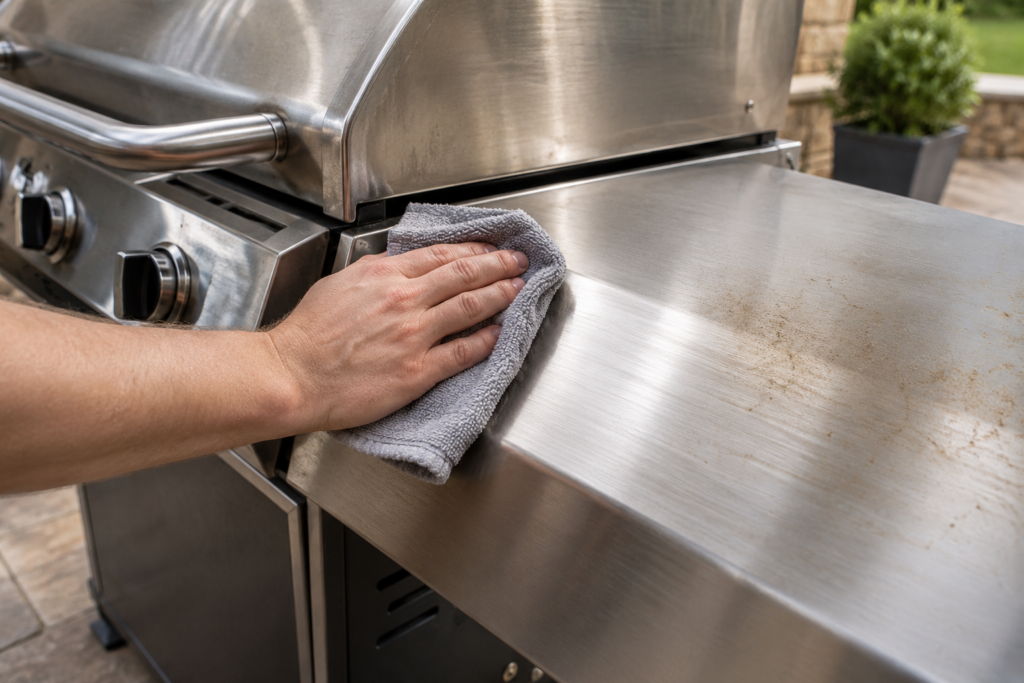
- Wipe with a damp cloth in the direction of the grain, covering the panels, handles and the front of the firebox.
- Rinse with fresh water if there was salt spray, pool splash or chlorine contact.
- Dry the surface, since standing water is where deposits begin.
- Apply a stainless cleaner or protectant formulated for outdoor use on the monthly schedule, such as Bar Keepers Friend or a DCS-approved stainless polish named in the notice.
- Cover the grill or outdoor refrigerator with a fitted cover when it is not in use for long periods, particularly in the off-season.
Our guides to how to clean a DCS grill and DCS grill maintenance cover the inside of the grill, where this guide stops.
Which Product for Which Job
Most owners own the wrong cleaner for at least one of these jobs, and the mistake shows up as scratches or a dull patch that never wipes clean. Keep it simple and match the product to the job.
- Damp cloth and fresh water — the everyday wipe, and the rinse after salt, pool splash or chlorine.
- Stainless cleaner or protectant for outdoor use — the monthly step, or after every cleaning on the coast.
- Non-abrasive oxalic acid cleaner — only for rust, followed by a thorough rinse and drying.
- Protective oil or stainless conditioner — the last coat after rust treatment.
If a product is not listed here, check the label for use on stainless steel and avoid anything that scours. Test any new product on a hidden corner first, and rinse it off completely, since residue left to dry in the sun can leave marks of its own.
What Do You Do About Rust on DCS Stainless?
Treat it at once, and treat it gently. The notice says to use a non-abrasive oxalic acid cleaner, rinse thoroughly, dry the surface and then apply a protective oil or stainless conditioner. Surface rust on 304 stainless is often just a cosmetic issue caused by chloride deposits, and our RUST-THRU code page says it can be removed with a stainless cleaner and does not by itself indicate structural failure.
That page is equally clear about the other end of the scale: holes in the firebox floor or walls, or burner tube pitting that has reached visible holes, mean the grill is unsafe to use. If the corrosion has affected valve bodies, burner tubes or electrical components, or if pitting has reached structural panels, the notice says to contact DCS customer support to assess whether a component needs replacing.
Coastal, Pool-Side and Off-Season Care
Where the weather is hardest, the routine has to be tighter. Salt air and pool chlorine are the two conditions the notice singles out, and the answer to both is frequency and fresh water. Store the grill under a fitted cover over winter, and read our outdoor appliance corrosion guide to see when the cost of corrosion tips a repair into a replacement.
Outdoor refrigerators need the same exterior care, and our outdoor refrigerator maintenance guide covers the rest. If you would rather hand the checks to someone else, the preventive maintenance visit covers a wider check, with pricing confirmed on site. You can book a visit or send us a photo of what you are seeing.