 Michael Torres
Key Takeaways
- This site lists board-level faults on a DCS wall oven from $250, and the final price is confirmed after on-site diagnosis.
- Diagnosis starts from $89 and you get a written estimate before any work begins.
- A 15-minute breaker reset and a check for a power surge are worth doing before you pay for a board.
- An oven that shows F5 or F1 should not be used until it is repaired.
The Bottom Line
Expect board faults to start from $250 on this site, with the final price set after diagnosis. Rule out a power event with a long breaker reset first, and do not use an oven showing F5 or F1.
A wall oven with a dark, garbled or unresponsive display is a frightening sight, because the display is the only way you talk to the oven. The part behind it is an electronic board, and boards are where an oven repair bill can jump. The honest answer to what it will cost depends on which board has failed and on whether something upstream, such as a power surge, caused it. This guide sets out what this site's own pages say about board faults on a DCS wall oven, what moves the price, and what to rule out before you pay for one. The price you will actually pay is confirmed after the technician diagnoses the oven on site.
| What the oven does | What it points to | Starting point on this site |
|---|---|---|
| F5 on every power-up, keys do nothing, garbled display | Main control board failure | From $250 |
| F1 returns within minutes of a breaker reset | Watchdog fault in the control board | From $250 |
| Keys or display behave oddly but no code | Needs testing to separate keypad, display and board | Diagnosis from $89 |
| PF after an outage, clock reset | Not a fault, just a power event | From $0, press any key |
What Is the DCS Wall Oven Display Board Replacement Cost?
This site's pages put board-level faults on a DCS wall oven from $250, and that is a starting point rather than a quote. The F5 code page and the F1 code page both list a typical repair from $250 and an hour or two of technician time. Neither page prices a display board on its own, so the figure to plan around is the control board's.
Diagnosis starts from $89. The final price is confirmed after the on-site diagnosis, and you receive a written estimate before any work begins. If the board needs replacing, that estimate is the number to compare, because it includes the part for your model and the labor to fit and test it.
The service page for DCS wall ovens says technicians read the fault codes and verify sensor resistance with a multimeter against factory specifications before ordering any parts, so that only what is actually faulty is replaced. That order of work protects you from paying for a board when a sensor or a connector was the real fault. A fault that looks like a board problem on the display can still turn out to be something smaller.
Which Symptoms Point to the Display or Control Board?
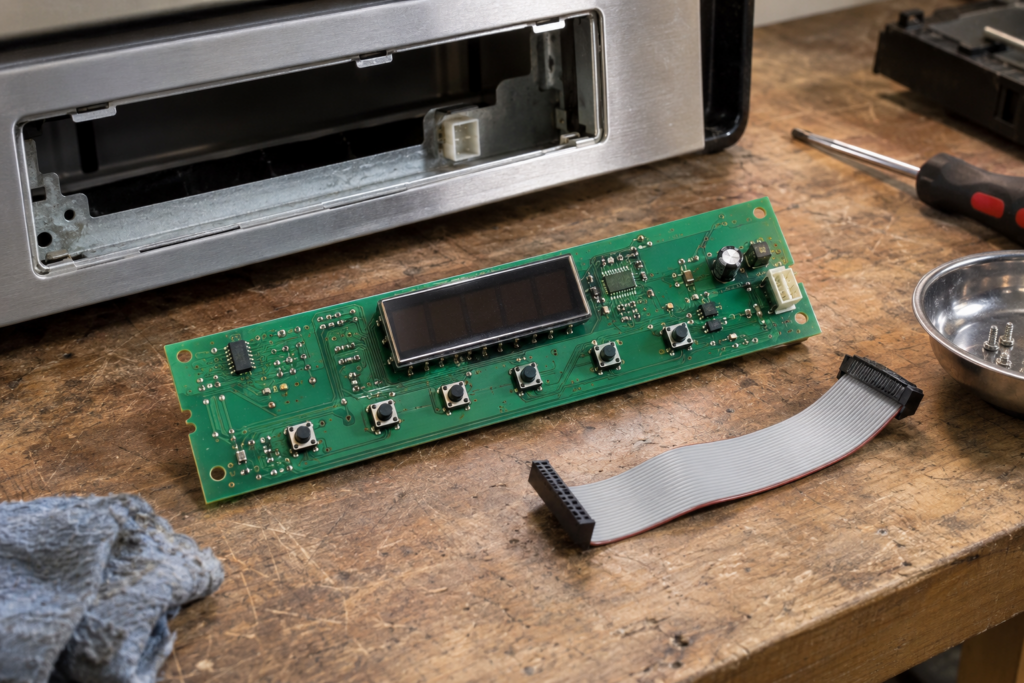
A set of symptoms on the F5 and F1 pages together describe a board that has stopped doing its job. They are worth writing down before the visit because they help the technician decide whether the display, the control board or both are involved.
- Garbled characters before the code — the F5 page says the display may cycle through random characters before settling on the fault code.
- Keys that do nothing — the board is not processing inputs, so pressing any key has no effect.
- A code on every power-up — the page says F5 on every power-up with no prior use almost always means board replacement is required.
- The oven freezing mid-cycle — the F1 page describes the elements switching off partway through a cook while the display shows the fault.
- Persistent beeping with the code — an alarm sounding along with F1 signals a critical board fault.
The pages are firm on one point: an oven in this state should not be used. The F5 page says the oven cannot safely regulate its heating elements or door locking, and that it should not be used until it is repaired.
Can You Rule Out a Power Problem Before Paying for a Board?
Yes, and it is worth ten minutes, because the pages say power events cause some of these faults. A surge or brownout can corrupt a board's firmware, and a long reset sometimes clears it.
- Switch off the oven's breaker for 15 minutes — the F5 page asks for this longer reset so the board's capacitors discharge fully.
- Restore power and watch — if the code clears, monitor for recurrence, since a one-time latch-up after a power event can resolve for good.
- Look at the main panel — a tripped breaker or a triggered surge protector suggests the board was hit by an event.
- Check the circuit — the oven should be on its own dedicated circuit at the correct voltage.
- Note the pattern — F5 straight away on power-up points at board replacement, and after a period of use it may point at something else.
If the oven shows only PF, it is not broken. The PF page calls it an informational notice that the oven lost power, cleared by pressing any key. If PF appears alongside F1 or F5, treat it as a board problem.
What Moves the Price Up or Down
Four things change what a board repair costs, and you control only one of them.
- Which board it is — the pages describe the control board that regulates heating and door locking, while a display or keypad part may be separate on your model. The technician confirms from the model number.
- Whether the cause is still active — a new board fitted to an oven with a power-quality problem can fail again, which is why the pages recommend a surge suppressor and a dedicated circuit.
- Whether the wiring is sound — the F1 page lists a loose or corroded connector among its causes, and a connector fault costs less than a board.
- Whether the oven is in warranty — the F1 page says a board replacement under warranty must be done by a certified technician to preserve coverage.
A diagnosis from our oven repair service reads the fault codes and tests the control system before any part is ordered, so you pay for the board only if the board is the cause.
How to Decide and What to Do Next
Book the diagnosis, read the written estimate, and then decide, because the decision depends on the age of the oven and the price of the repair. Our DCS oven worth repairing guide sets out the usual thresholds, and the oven repair costs guide puts board faults beside sensors, igniters and door locks. If the oven is under warranty, read what DCS warranty coverage includes first.
Have the model and serial number, a photo of the display and the time the fault first appeared ready when you call. You can book a visit or send us the model number and a photo of the display. Meanwhile, leave the oven switched off at the breaker.
Once the oven is repaired, protect the new board. The F5 and F1 pages both recommend a whole-home surge suppressor and a dedicated circuit for the wall oven, since both faults can follow a utility surge or a brownout. It is a small cost beside a second board.